logo
Courses
    logo
  • Courses
  • Corporate Training
  • Testimonials

Internet of Things (IoT)

  • Learn how IoT components fit together in an architecture
  • Practise enabling technologies in hands-on lab activities
  • Identify IoT security risks and their common causes
  • Explore IoT monetization strategies and business models
Accredited Training
4.5/5Trustpilot

Google4.8/5
6232Enrolled Learners

Connected devices only deliver value when the business case, the architecture and the security hold together. This IoT course in Dubai covers all three, moving from business orientation and architecture through enabling technologies, security and case studies. It suits professionals who already know networking, a programming language, cloud, databases and analytics. You don't need any earlier IoT projects to begin.
Why Take Internet of Things (IoT)

If you work with connected devices or plan to, this course gives you a clear view of the whole subject. You start with IoT concepts and terminology, then move to business drivers, challenges and monetization models, followed by architecture and network protocols. Big data, analytics and cloud computing come next, with lab activities to practise them. You then look at security and governance, and finish with case studies and future predictions. If you already know networking, programming and cloud basics, this is a practical next step in Dubai.

Extend skills you already have The course assumes working knowledge of networking, programming and cloud or data analytics. It suits professionals moving into connected-device work, not beginners starting from zero.

Learn how IoT systems fit together You study the architecture of IoT components and the network protocols they use. The opening module also covers the terminology, including how IoE, M2M and IoT differ, which helps in project discussions and interviews.

Practise with data and cloud technologies The module on SMACT, big data and analytics, and cloud computing includes lab activities. That hands-on work supports roles where IoT meets data and cloud platforms.

Apply IoT to your own sector in Dubai Case studies on usage scenarios, growth perspectives and future predictions give you a way to judge where IoT applies in your industry. The security and business modules, covering breach causes, risks, monetization models and benefits, help you speak to stakeholders beyond the technical team.

Who Should Take Internet of Things (IoT)

Aspiring IoT Professionals

If you're early in your career and want to work with connected systems, the course covers IoT concepts, architecture, and enabling technologies. It gives you a structured base to build on.

Network Engineers

See how the protocols you already know fit into IoT. The course covers IoT architecture components and the network protocols used within them.

Software Developers

If you write code for apps, platforms, or devices, you'll see where your work sits in an IoT system. The course covers architecture, cloud computing, big data, and analytics.

Upcoming Sessions

Classroom Training

Get it at Enquire

Loading available sessions…
AI IntegratedActivities/Case Study
Enroll now

Online Training

Get it at Enquire

Loading available sessions…
AI IntegratedActivities/Case Study
Enroll now

Learn now, pay later

Career Benefits of Internet of Things (IoT)

IoT training can add practical value to your profile in Dubai, depending on how you apply it. The course covers architecture, protocols, security, analytics, cloud and monetization, so you can join technical discussions, assess security risks and link connected projects to business cases. It also builds technical and commercial understanding that may support a move toward senior roles. It does not guarantee a job or promotion.

Prerequisites

Basic knowledge of computer networking and protocols such as TCP/IP and HTTP.

Familiarity with a programming language such as C, C++, Java, Python or JavaScript.

An understanding of cloud computing, databases and data analytics.

No earlier hands-on IoT projects are needed.

Internet of Things (IoT) Curriculum

Module 1: Prerequisties

  • Basic knowledge of computer networking and protocols such as TCP/IP, HTTP, and many more
  • Knowledge of programming languages such as C, C++, Java, Python, and JavaScript
  • Understanding of cloud computing, databases, and data analytics
—Course Duration
—Course Duration
—Corporate Days
6232Enrolled Learners

Learning Outcomes

After completing the Internet of Things (IoT) course in Dubai, you will be able to do the following

  1. 1

    Define the Internet, Things and IoT, and explain how IoT developed over time, including how it differs from IoE and M2M and where cyber-physical systems fit.

  2. 2

    Identify where IoT is used, read the facts and figures that show its scale, and examine real usage scenarios.

  3. 3

    Weigh the opportunities, benefits and challenges of an IoT business, and compare monetization strategies and models.

  4. 4

    Describe the components of an IoT system, how they fit together, and the protocols that connect devices.

  5. 5

    Explain how social media, mobility, big data, analytics and cloud computing (SMACT) support IoT.

  6. 6

    Recognise IoT security challenges, the causes of breaches and the risks they create.

Meet your Trainer

Our Trainers

Learners Point Certificate

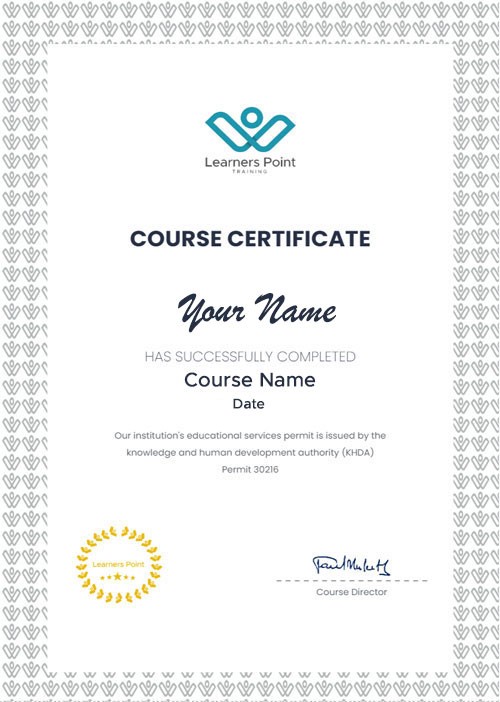
Earn a Course Completion Certificate, an official Learners Point credential that confirms that you have successfully completed a course with us.

Learners Point Certificate

Frequently asked questions about Internet of Things (IoT)

An IoT certification is a credential showing you understand how connected devices, networks, data and software work together. It covers how physical objects collect and share data, how that data moves across networks, how organisations use it, and security. Learners Point Academy's course in Dubai covers these areas.

The IoT course covers seven areas. These include core concepts and terminology, business drivers and monetization, IoT architecture and network protocols, and enabling technologies with lab activities such as big data and cloud computing. It also covers security risks, case studies and future predictions.

You need three things before enrolling. These are basic computer networking and protocols like TCP/IP and HTTP, some programming in C, C++, Java, Python or JavaScript, and an understanding of cloud computing, databases and data analytics. Working familiarity is enough. Confirm any other entry requirements with the academy.

An IoT certification suits working professionals who deal with connected devices, data or the systems around them. Network engineers, software developers and data or cloud professionals fit best, since the course expects some networking, programming and cloud knowledge. People who plan IoT projects or handle security can benefit too.

Yes. Learners Point Academy lists an Internet of Things course for learners in Dubai. The page does not give the schedule, format or venue, so confirm those with the Academy. Check the prerequisites too, which include basic networking, a programming language and some cloud and data knowledge.

Industries that manage physical assets, equipment or movement benefit most from IoT. Manufacturing, logistics, energy and utilities, healthcare, retail, agriculture, and smart buildings and cities all use sensors and connected devices. IoT pays off where better data leads to faster decisions or lower operating costs.

IoT training is in demand because connected devices now run through logistics, utilities, retail and healthcare, and employers need people who understand them. Security is a big reason, since every device is a possible entry point. Dubai specific hiring figures aren't covered here.

Do you want to learn more about Learners Point Academy?

  • Learn more about courses
  • Understand about our methodology
  • Let’s talk about Corporate trainings
  • Anything else that you want to know, we are here for you!

Let's chat!

  • Afghanistan+93
  • Albania+355
  • Algeria+213
  • Andorra+376
  • Angola+244
  • Antigua and Barbuda+1268
  • Argentina+54
  • Armenia+374
  • Aruba+297
  • Australia+61
  • Austria+43
  • Azerbaijan+994
  • Bahamas+1242
  • Bahrain+973
  • Bangladesh+880
  • Barbados+1246
  • Belarus+375
  • Belgium+32
  • Belize+501
  • Benin+229
  • Bhutan+975
  • Bolivia+591
  • Bosnia and Herzegovina+387
  • Botswana+267
  • Brazil+55
  • British Indian Ocean Territory+246
  • Brunei+673
  • Bulgaria+359
  • Burkina Faso+226
  • Burundi+257
  • Cambodia+855
  • Cameroon+237
  • Canada+1
  • Cape Verde+238
  • Caribbean Netherlands+599
  • Cayman Islands+1
  • Central African Republic+236
  • Chad+235
  • Chile+56
  • China+86
  • Colombia+57
  • Comoros+269
  • Congo+243
  • Congo+242
  • Costa Rica+506
  • Côte d'Ivoire+225
  • Croatia+385
  • Cuba+53
  • Curaçao+599
  • Cyprus+357
  • Czech Republic+420
  • Denmark+45
  • Djibouti+253
  • Dominica+1767
  • Dominican Republic+1
  • Ecuador+593
  • Egypt+20
  • El Salvador+503
  • Equatorial Guinea+240
  • Eritrea+291
  • Estonia+372
  • Ethiopia+251
  • Fiji+679
  • Finland+358
  • France+33
  • French Guiana+594
  • French Polynesia+689
  • Gabon+241
  • Gambia+220
  • Georgia+995
  • Germany+49
  • Ghana+233
  • Greece+30
  • Greenland+299
  • Grenada+1473
  • Guadeloupe+590
  • Guam+1671
  • Guatemala+502
  • Guinea+224
  • Guinea-Bissau+245
  • Guyana+592
  • Haiti+509
  • Honduras+504
  • Hong Kong+852
  • Hungary+36
  • Iceland+354
  • India+91
  • Indonesia+62
  • Iran+98
  • Iraq+964
  • Ireland+353
  • Israel+972
  • Italy+39
  • Jamaica+1876
  • Japan+81
  • Jordan+962
  • Kazakhstan+7
  • Kenya+254
  • Kiribati+686
  • Kosovo+383
  • Kuwait+965
  • Kyrgyzstan+996
  • Laos+856
  • Latvia+371
  • Lebanon+961
  • Lesotho+266
  • Liberia+231
  • Libya+218
  • Liechtenstein+423
  • Lithuania+370
  • Luxembourg+352
  • Macau+853
  • Macedonia+389
  • Madagascar+261
  • Malawi+265
  • Malaysia+60
  • Maldives+960
  • Mali+223
  • Malta+356
  • Marshall Islands+692
  • Martinique+596
  • Mauritania+222
  • Mauritius+230
  • Mexico+52
  • Micronesia+691
  • Moldova+373
  • Monaco+377
  • Mongolia+976
  • Montenegro+382
  • Morocco+212
  • Mozambique+258
  • Myanmar+95
  • Namibia+264
  • Nauru+674
  • Nepal+977
  • Netherlands+31
  • New Caledonia+687
  • New Zealand+64
  • Nicaragua+505
  • Niger+227
  • Nigeria+234
  • North Korea+850
  • Norway+47
  • Oman+968
  • Pakistan+92
  • Palau+680
  • Palestine+970
  • Panama+507
  • Papua New Guinea+675
  • Paraguay+595
  • Peru+51
  • Philippines+63
  • Poland+48
  • Portugal+351
  • Puerto Rico+1
  • Qatar+974
  • Réunion+262
  • Romania+40
  • Russia+7
  • Rwanda+250
  • Saint Kitts and Nevis+1869
  • Saint Lucia+1758
  • Saint Vincent and the Grenadines+1784
  • Samoa+685
  • San Marino+378
  • São Tomé and Príncipe+239
  • Saudi Arabia+966
  • Senegal+221
  • Serbia+381
  • Seychelles+248
  • Sierra Leone+232
  • Singapore+65
  • Slovakia+421
  • Slovenia+386
  • Solomon Islands+677
  • Somalia+252
  • South Africa+27
  • South Korea+82
  • South Sudan+211
  • Spain+34
  • Sri Lanka+94
  • Sudan+249
  • Suriname+597
  • Swaziland+268
  • Sweden+46
  • Switzerland+41
  • Syria+963
  • Taiwan+886
  • Tajikistan+992
  • Tanzania+255
  • Thailand+66
  • Timor-Leste+670
  • Togo+228
  • Tonga+676
  • Trinidad and Tobago+1868
  • Tunisia+216
  • Turkey+90
  • Turkmenistan+993
  • Tuvalu+688
  • Uganda+256
  • Ukraine+380
  • United Arab Emirates+971
  • United Kingdom+44
  • United States+1
  • Uruguay+598
  • Uzbekistan+998
  • Vanuatu+678
  • Vatican City+39
  • Venezuela+58
  • Vietnam+84
  • Yemen+967
  • Zambia+260
  • Zimbabwe+263