Diploma in International Financial Reporting
5-day program to master IFRS principles
Execute complex financial reporting & group consolidations
Prepare for the ACCA DipIFR exam with mock simulations
Learn from qualified experts with industry experience
Secure a globally recognised DipIFR qualification
Pay in easy instalments & gain careers in accounting

 4.7/5
4.7/54900 EnrolledEnrolled Learners
4.7/54900 EnrolledEnrolled Learners
Overview
What will you learn from us:
- Master key IFRS standards like revenue recognition, financial instruments, and asset impairment through real cases
- Prepare single-entity and consolidated financial statements with hands-on exercises and real-world scenarios
- Learn from experienced IFRS trainers offering expert guidance and real-world insights throughout the course
- Full-length mock exams and exam-answering techniques to help you confidently tackle the DipIFR exam
- Interactive learning with case studies, calculations, and group discussions to simplify complex IFRS concepts
- Ongoing support from instructors and peers, ensuring you have guidance at every stage of learning
Upcoming sessions
Curriculum
1
Structure of the IFRS Foundation
2
Role of the International Accounting Standards Board (IASB)
3
Due process & standard-setting procedures
4
IFRS Interpretations Committee
5
Global adoption of IFRS
6
Analyze IFRS recognition scenarios and framework applications.
7
Generate structured IFRS summaries and revision notes.
1
Objective of financial reporting
2
Qualitative characteristics of useful information
3
Elements of financial statements
4
Recognition & derecognition
5
Measurement bases
6
Capital maintenance concepts
7
IFRS 8 Operating Segments
8
IFRS S1 General Requirements for Disclosure of Sustainability-related Financial Information
9
IFRS S2 Climate-related Disclosures
10
Review disclosure requirements and sustainability reporting obligations.
11
Assess ethical reporting risks and judgement-based decisions.
1
IAS 1 Presentation of Financial Statements
2
IAS 7 Statement of Cash Flows
3
IAS 8 Accounting Policies, Changes in Estimates and Errors
4
IAS 10 Events after the Reporting Period
5
IAS 24 Related Party Disclosures
6
IFRS 15 Revenue from Contracts with Customers (5-Step Model)
7
IAS 37 Provisions, Contingent Liabilities & Contingent Assets
8
IAS 12 Income Taxes
9
IAS 2 Inventories
10
Evaluate revenue recognition and inventory valuation scenarios.
11
Interpret tax implications and provision assessments.
1
IAS 16 Property, Plant and Equipment
2
IAS 23 Borrowing Costs
3
IAS 40 Investment Property
4
IFRS 5 Non-current Assets Held for Sale
5
IAS 36 Impairment of Assets
6
Review impairment indicators and asset accounting treatments.
7
Analyze valuation methods and disclosure requirements.
1
IFRS 9 Financial Instruments Classification and Expected Credit Loss Models
2
IFRS 7 Financial Instruments Disclosures
3
IFRS 13 Fair Value Measurement Hierarchy and Valuation Principles
4
Classify financial instruments and expected credit loss scenarios.
5
Assess fair value measurements and reporting implications.
1
IFRS 16 leases
2
IAS 38 intangibles
3
IFRS 2 share-based payments
4
IAS 19 employee benefits
5
IAS 33 EPS
6
Analyze lease accounting and employee benefit obligations.
7
Review EPS calculations and disclosure requirements.
1
IFRS 3 Acquisition Method
2
Goodwill and Non-Controlling Interest (NCI)
3
Intra-group Adjustments
4
Consolidation Principles and Group Reporting Methodologies
5
IAS 28 Associate Adjustments
6
Partial Disposal Considerations
7
Equity Accounting Adjustments
8
Fair Value Adjustments in Associates
9
Evaluate acquisition accounting and goodwill calculations.
10
Review consolidation adjustments and group reporting scenarios.
1
IAS 28 Associates
2
IAS 21 The Effects of Changes in Foreign Exchange Rates
3
Advanced Consolidation Adjustments and Group Reporting Scenarios
4
IFRS for SMEs Overview and Simplified Reporting Considerations
5
DipIFR Exam Answering Techniques and Revision Methodologies
6
Analyze foreign currency and associate accounting scenarios.
7
Support exam preparation through targeted technical reviews.
Meet your Trainer
Dr. Srinivas, PhD., MSc., MBA, LLB, CMA, CPA, PMP
Dr. Srinivas Reddy is a skilled Corporate Trainer with a solid finance background and diverse credentials. He delivers effective learning solutions for finance and accounting teams, specializing in financial, cost, and tax accounting.
Dr. Reddy, a resourceful trainer, creates engaging and effective learning environments. He is dedicated to assessing training needs and closely monitors progress to provide relevant guidance, boosting participants' skills and productivity.
Dr. Reddy is not just a corporate trainer; he’s also deeply involved in community service. His commitment to both personal and professional growth makes him stand out.
Core Competencies:
- Exceptional competency in the finance domain
- Outstanding communication & presentation skills
- Strong teaching proficiency
- Expertise across different verticals
Professional Qualifications:
- Certified Public Accountant (CPA), The American Institute of Certified Public Accountants, U.S.A
- Certified Management Accountant (CMA), The Institute of Management Accountants, USA
- Certified Fraud Examiner (CFE), Association of Fraud Examiners, USA
- Certified Cost Accountant (ICWA), The Institute of Cost and Works Accountants of India, India
- Project Management Professional (PMP), Project Management Institute

Learning Outcomes
By the end of the course, you will:
1
Develop a strong conceptual and technical understanding of IFRS standards and their practical application
2
Master single-entity and group financial reporting, including consolidation and business combinations
3
Apply professional judgement in complex reporting scenarios
4
Strengthen technical calculation skills for revenue, financial instruments, leases, impairment, taxation, and fair value measurement
5
Prepare participants strategically for the DipIFR examination using exam-oriented techniques and full mock simulations
6
Enhanced professional capabilities and credibility in the finance domain

KHDA Certificate
Earn a KHDA attested Course Certificate. The Knowledge and Human Development Authority (KHDA) is the educational quality assurance and regulatory authority of the Government of Dubai, United Arab Emirates.
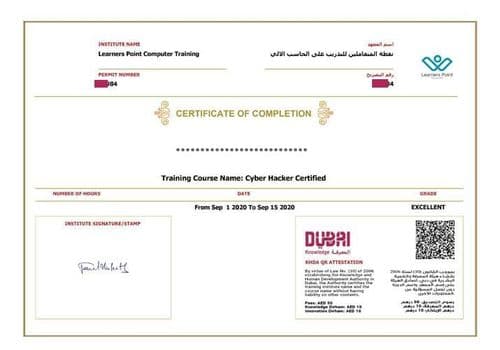
Learners Point Certificate
Earn a Course Completion Certificate, an official Learners Point credential that confirms that you have successfully completed a course with us.

Prerequisites
The eligibility requirements to attain a Diploma in IFRS course are as follows:
- 2 years of relevant accounting experience with a related degree (exemptions for the Applied Knowledge and Corporate and Business Law (LW) exams
- 2 years of relevant accounting experience coupled with a Certificate in IFRS
- 3 years of relevant accounting experience
Overall ratings by our students
Related courses
Frequently asked questions
The DipIFR course equips you with advanced IFRS knowledge, strong consolidation skills, and the ability to handle complex reporting issues with confidence. It combines technical learning with scenario-based practice, mock exams, and examiner-focused answering techniques. As a result, you improve both your financial reporting accuracy and exam readiness, while building skills that are highly valuable in audit, compliance, and international finance roles.
The eligibility requirements to attain a Diploma in International Financial Reporting are as follows:
1)2 years of accounting experience with a related degree (exemptions for the Applied Knowledge and Corporate and Business Law (LW) exams
2)2 years of pertinent accounting experience coupled with an Certificate in IFRS
3)3 years of pertinent accounting experience
Here are the key modules covered in the Diploma in IFRS:
- IFRS Environment and Conceptual Framework
- Presentation and Ethical Judgement
- Revenue, Provisions, Tax and Inventory
- Asset Accounting and Impairment
- Financial Instruments and Fair Value
- Leases, Employee Benefits and EPS
- Business Combinations and Consolidation
- Advanced Group Accounting and Exam Preparation
The Diploma in IFRS prepares you for the DipIFR exam by combining technical IFRS coverage with exam-focused practice. You learn how to interpret standards, solve complex reporting scenarios, prepare consolidated financial statements, and apply professional judgement under exam conditions. The program also strengthens your answering technique through structured case studies, calculation exercises, and full-length mock tests, helping you improve accuracy, time management, and confidence before the final examination.
This Diploma in IFRS stands out because it goes beyond general finance theory and builds specialist expertise in international financial reporting. It combines examiner-focused training, full-length mock exams, scenario-based practice, and an integrated IFRS case study covering consolidation, leases, revenue, tax, and financial instruments. Learners also strengthen professional judgement, technical accuracy, and answer-structuring skills, making the program highly practical for both certification success and workplace reporting responsibilities in global roles.
Yes, this Diploma in International Financial Reporting can strongly support career growth. It builds advanced IFRS knowledge, strengthens your ability to handle complex reporting and consolidation tasks, and improves exam-focused problem-solving skills. Employers value professionals who can apply reporting standards accurately and exercise sound judgement. This training can help you progress towards roles in financial reporting, audit, compliance, group accounting, and finance functions within multinational organizations.
The major differences between IPSAS & IFRS Certification are as follows:
-
IPSAS has established no-exchange transactions that encompass public-sector-specific standards. IPSAS 23 covers revenues arising from taxes, grants, fines, and levies.
-
IFRS has no such standards as it believes that such transactions are not required for private sector entities.
The benefits of earning IFRS Certification are as follows:
1) Builds Professional Foundation
2) Helping hand in the better functioning of businesses
3) Globally recognised qualification standards
4) Better job opportunities
Many MNCs are looking for professionals after completion of the Diploma in International Financial Reporting. The companies are as follows:
1)PwC
2)Deloitte
3)KPMG
4)EY
5)Grant Thornton
The training materials are regularly updated to incorporate the latest IFRS changes and revisions, ensuring that participants are well-informed on current standards.
This Diploma in International Financial Reporting helps to understand the practical application of IFRS concepts and principles in the global business arena. We also assist professionals in applying IFRS principles to ensure accurate financial reporting.
Learners Point offers expert-led DipIFR training with industry-experienced instructors, real-world case studies, and hands-on practice. We focus on exam preparation through interactive sessions, mock exams, and continuous support, ensuring learners are fully equipped for success in real-world financial reporting.
The DipIFR exam consists of 4 compulsory long-form questions, including case studies, calculations, and written explanations. The total duration is 3 hours and 15 minutes, and the exam is graded out of 100 marks. The passing mark is 50%.
Do you want to learn more about Learners Point Academy?
- Learn more about courses
- Understand about our methodology
- Let’s talk about Corporate trainings
- Anything else that you want to know, we are here for you!