CMA Course - #1 US CMA Certification Program
CMA with IMA Gold Partner unlimited expert-led training
12 modules with industry simulation & mock tests
Complimentary IMA membership & entrance fee support
Full mock exams and complete test bank access
Live expert-led doubt-clearing sessions
HOCK premium CMA study materials & test banks
Flexible LMS-enabled learning options with easy instalments

 4.9/5
4.9/54000 EnrolledEnrolled Learners
4.9/54000 EnrolledEnrolled Learners
Overview
What our course does for you:
- Provides professional advancement through CMA course
- Inculcates critical skill sets & concepts in accounting and finance
- Prepares participants for the CMA Part 1 & Part 2 exam
- Helps achieve worldwide recognition
- Enhances credibility to work globally
- Includes real-world projects and interactive learning activities
Upcoming sessions
Curriculum
1
CMA structure and scoring
2
Case-based MCQs and scenarios
3
Study planning strategy
4
Exam approach techniques
5
Time management strategies
1
Financial statements analysis
2
GAAP vs IFRS
3
Disclosure requirements
4
Reporting frameworks
5
Financial interpretation
1
Flexible and static budgets
2
Forecasting models
3
Variance analysis
4
Budget planning
5
Financial projections
1
Standard costing
2
Activity-based costing
3
Cost allocation
4
Cost behavior
5
Cost control strategies
1
KPIs and balanced scorecard
2
Financial ratios
3
Internal control frameworks
4
Performance evaluation
5
Governance systems
1
Big data in accounting
2
Automation
3
Analytics tools
4
Data interpretation
5
Financial technology applications
1
Time value of money
2
Discounted cash flow
3
Capital budgeting
4
Financial decision-making
5
Investment evaluation
1
Risk-return relationship
2
CAPM
3
Portfolio analysis
4
Investment risk
5
Financial modeling
1
Ratio analysis
2
Trend analysis
3
Comparative analysis
4
Financial evaluation
5
Performance comparison
1
Ethical frameworks
2
Decision trees
3
Sensitivity analysis
4
Break-even analysis
5
Governance ethics
1
NPV, IRR, Payback
2
Discounted cash flow
3
Risk-adjusted returns
4
Investment appraisal
5
Capital rationing
1
Ethical standards
2
IMA ethics framework
3
Conflict resolution
4
Governance principles
5
Compliance
Meet your Trainer
Dr. Srinivas, PhD., MSc., MBA, LLB, CMA, CPA, PMP
Dr. Srinivas Reddy is a skilled Corporate Trainer with a solid finance background and diverse credentials. He delivers effective learning solutions for finance and accounting teams, specializing in financial, cost, and tax accounting.
Dr. Reddy, a resourceful trainer, creates engaging and effective learning environments. He is dedicated to assessing training needs and closely monitors progress to provide relevant guidance, boosting participants' skills and productivity.
Dr. Reddy is not just a corporate trainer; he’s also deeply involved in community service. His commitment to both personal and professional growth makes him stand out.
Core Competencies:
- Exceptional competency in the finance domain
- Outstanding communication & presentation skills
- Strong teaching proficiency
- Expertise across different verticals
Professional Qualifications:
- Certified Public Accountant (CPA), The American Institute of Certified Public Accountants, U.S.A
- Certified Management Accountant (CMA), The Institute of Management Accountants, USA
- Certified Fraud Examiner (CFE), Association of Fraud Examiners, USA
- Certified Cost Accountant (ICWA), The Institute of Cost and Works Accountants of India, India
- Project Management Professional (PMP), Project Management Institute

Learning Outcomes
Upon finishing the training, you will:
1
Gain expertise in strategic decision-making, compliance, costing, accounting, and taxation
2
Explore planning and cost management concepts
3
Acknowledge the critical role of budgeting in evaluation processes
4
Master analytical skills using sensitivity analysis techniques
5
Develop the ability to suggest appropriate performance measures

Learners Point Certificate
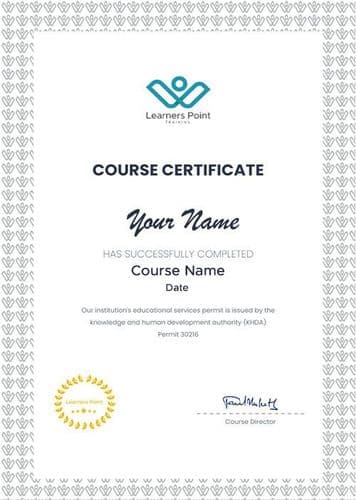
Earn a Course Completion Certificate, an official Learners Point credential that confirms that you have successfully completed a course with us.
Prerequisites
To attend our CMA course, the eligibility requirements is:
- Anybody can take the CMA exam, a junior or working professinal, or a fresh graduate. Two years of work experience is required before one receives the CMA certification awarded by the IMA.
Overall ratings by our students
Related courses
Frequently asked questions
The CMA course prepares candidates for the Certified Management Accountant (CMA) credential awarded by the Institute of Management Accountants. The CMA exam has two parts and tests management accounting, performance analytics, and strategic financial management.
The certification is globally recognised and has been established for nearly 50 years, making it a widely respected credential for professionals aiming to advance in financial management and management accounting roles.
To attend the training program, the eligibility requirement is as follows:
- Anybody can take the CMA exam, a junior or working professinal, or a fresh graduate. Two years of work experience is required before one receives the CMA certification awarded by the IMA.
HOCK materials typically include online textbooks, video lectures, a large practice test bank with explanations, and dedicated mock exams for final preparation. Listing what you provide helps learners compare options confidently.
Completing the CMA course at Learners Point equips you with globally recognised financial expertise, which can boost your career prospects. With the knowledge gained, you will be prepared for leadership roles in finance, accounting, and strategy.
Professionals can secure higher-paying positions in top companies after completing our course. The CMA course adds credibility and sets you apart in the competitive job market.
Candidates often fear failing the CMA exam, not having enough study time, or lacking confidence.
To manage these fears, candidates should follow a structured study schedule, allocate dedicated time for preparation, and focus on maintaining a positive mindset. Effective exam preparation, combined with consistency and expert guidance, can alleviate anxiety and boost confidence.
To become a Certified Management Accountant, professionals should meet the following criteria:
- Hold an active IMA membership
- Complete and pass Parts 1 and 2 of the CMA Exam
- Hold a bachelor’s degree from an accredited college/university or a related professional certification (For details, please refer to the Education Qualification Section of the CMA Handbook)
- Abide by IMA’s Statement of Ethical Professional Practice
CMA-qualified professionals commonly move into roles that combine financial control with planning, analysis, and decision support across corporate finance teams.
- Corporate Controller
- Senior Accountant
- Chief Financial Officer
- Financial Analyst
- Cost Accountant
- Management Accountant
- Financial Risk Manager
These roles typically draw on CMA capabilities in budgeting and forecasting, performance management, cost strategy, internal controls, and strategic finance leadership to support stronger business decisions.
Before preparing for the CMA exam, candidates should be aware of the essential expenses involved. These include registration fees, exam fees, and the cost of study materials. Additional costs may arise if candidates opt for preparatory courses, mock exams, or other resources.
It is important to plan ahead for these expenses to ensure proper financial preparation for the exam journey. Understanding all associated costs can help candidates manage their budget effectively.
CPA certification is generally more commonly recognised in public accounting and auditing roles. The CMA certification is highly valued for management accounting and financial management roles in corporate settings. The choice between the two certifications depends on one's career goals and decide which accounting certification is the best.
Improving your CMA exam score requires a strategic approach and disciplined preparation. Pro tips to improve your CMA exam score include thoroughly understanding the exam content and format.
Make use of a variety of study resources, such as mock exams, practice questions, and video lessons. Create a consistent study schedule, track your progress, and focus on areas where you need more practice. This focused approach will boost your confidence and help you achieve a higher score.
Successfully clearing part 2 of the CMA exam requires a combination of various strategies. These include expert study techniques such as active preparation, effective time management, and a complete understanding of the exam content.
CMA training in Dubai offers flexibility, making it suitable for working professionals who want to balance their studies alongside job responsibilities. We also offer CMA training globally, across locations to help aspirants earn this certification.
MBA and CMA serve different goals. An MBA is a broad management qualification, while CMA is a specialised finance credential focused on management accounting, performance analytics, and strategic financial management. Choose CMA when the goal is a finance-specialist credential for corporate decision support and performance management.
Choose an MBA when the goal is broader management scope across functions such as strategy, operations, and leadership. Many professionals complete CMA first to build a focused finance track, then add an MBA later to expand leadership breadth.
The CMA course is highly regarded as it combines accounting skills with strategic thinking and business insight. It prepares professionals to interpret financial data and guide key decisions effectively. Widely recognised, this certification boosts credibility, opens career opportunities, and supports growth into leadership roles.
The ICMA medals are awarded to the top three performers in the CMA exam for each testing window. Candidates who achieve the highest, second-highest, and third-highest scores are awarded gold, silver, and bronze medals, respectively.
These medals serve as a prestigious recognition of the exceptional performance and dedication of the candidates, highlighting the importance of thorough preparation, such as the one provided by our official Gold CMA course provider.
To maintain the CMA credential, CMAs are required to complete 30 hours of continuing professional education each year, including at least 2 hours in ethics, and keep membership and maintenance payments active.
- Complete 30 CPE hours per calendar year
- Ensure at least 2 CPE hours are in ethics annually
- Renew IMA membership and pay the CMA annual maintenance fee
There are 100 multiple-choice questionss in each part of the CMA exam, which account for 75% of the total score.
Case based questions has become the standard format for the CMA exam. Each case-based question (CBQ) exam has 100 MCQs and two CBQ sets. CMA exam format per part:
- Duration: 4 hours
- 3 hours: Complete the multiple-choice section and 1 hour: Complete both CBQs (2 case-based scenarios)
- MCQs: 100 questions (75% of the total score)
- 2 case-based scenario tasks (25% of the total score)
Do you want to learn more about Learners Point Academy?
- Learn more about courses
- Understand about our methodology
- Let’s talk about Corporate trainings
- Anything else that you want to know, we are here for you!